
Shoulder & Elbow Trauma Surgeon in Ahmedabad, Gujarat
Repairing Shoulder and Elbow Fractures
Falls onto an outstretched arm are the most common cause of shoulder and elbow trauma, ranging from a simple clavicle fracture to a complex fracture-dislocation of the elbow. Dr. Hiren Patel treats upper limb trauma in Ahmedabad with fixation planned to restore the arc of motion these joints need for everyday tasks, at PMG Hospital.
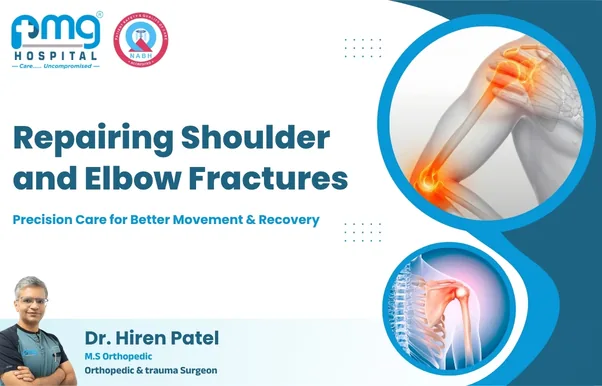
- Proximal humerus (shoulder) fracture fixation
- Clavicle (collarbone) fracture surgery
- Elbow fracture-dislocation reconstruction
- Radial head and olecranon fracture repair
What is shoulder and elbow trauma surgery?
Shoulder and elbow trauma surgery repairs fractures and fracture-dislocations of the upper limb so the arm regains the movement it needs for daily life. The shoulder and elbow are movement joints rather than weight-bearing ones, so the priority is different from a leg fracture: the aim is to rebuild the joint surface and stability accurately enough to restore a smooth, pain-free arc of motion - reaching overhead, bending and straightening the elbow, and turning the palm up and down.
Common shoulder and elbow trauma
Most of these injuries follow a fall onto an outstretched hand or a direct blow, and the pattern depends on how the force travels up the arm.
- Proximal humerus (upper arm / shoulder) fractures
- Clavicle (collarbone) fractures
- Elbow fracture-dislocations
- Radial head and neck fractures
- Olecranon (elbow tip) fractures
Treatment approach
Many minor, non-displaced fractures around the shoulder and elbow heal well without surgery, in a sling or brace with early guided movement. Displaced fractures - especially those involving the joint surface, or an unstable fracture-dislocation - are fixed with plates, screws or wires to restore the anatomy needed for a functional arc of movement. Around the elbow tip and kneecap-like surfaces where a tendon pulls the fragments apart, a tension-band wire is often used, and a badly damaged radial head may occasionally be replaced. The guiding principle is stable enough fixation to allow the joint to start moving early.
Recovery and regaining motion
The elbow in particular stiffens quickly after injury, so early, guided movement is prioritised as soon as the fixation allows - this is the single most important factor in getting a useful elbow back. Structured physiotherapy over several months restores strength and range of motion, and most patients regain functional use for daily activities. Shoulder fractures follow the shoulder's phased rehabilitation, protecting healing before active movement and strengthening are added, and full recovery of strength and confident overhead or lifting use continues for several months.

- Experience
- 14+ years
- Surgeries
- 14,000+
Shoulder and elbow trauma Surgery specialist in Ahmedabad
Upper-limb fractures reward accurate reconstruction and a rehabilitation plan that gets the joint moving early, because a stiff shoulder or elbow can be as limiting as the original injury. Dr. Hiren Patel is an orthopaedic surgeon in Ahmedabad with 14+ years of practice and 14,000+ surgeries at PMG Hospital, treating clavicle, proximal humerus, radial head and olecranon fractures and elbow fracture-dislocations. When choosing a shoulder and elbow trauma doctor or hospital in Ahmedabad, accurate fixation of the joint surface and an early-motion rehabilitation plan matter most. Learn more about Dr. Hiren Patel or explore the wider trauma and fracture care.
Frequently asked questions
Does a broken collarbone always need surgery?
No. Most clavicle (collarbone) fractures heal well without surgery, in a sling, because the collarbone has a good blood supply and tolerates minor angulation. Surgery is considered when the bone is badly displaced or shortened, has broken into several pieces, has pierced the skin, or fails to heal - where a plate and screws restore alignment and speed recovery.
Why does the elbow stiffen so easily after trauma?
The elbow is especially prone to stiffness because the joint capsule scars and tightens readily after injury and surgery, and pain makes patients hold the arm still, which quickly reduces movement. This is why fixation is planned to be stable enough for early, guided motion, and why physiotherapy starts as soon as it is safe rather than after the fracture has fully healed.
How long before I regain full shoulder or elbow movement?
Most patients regain functional movement for daily activities over a few months, with strength and the last of the range continuing to improve for up to a year. The exact timeline depends on the fracture, whether the joint surface was involved, and how consistently the early-motion physiotherapy programme is followed.
What is an elbow fracture-dislocation?
An elbow fracture-dislocation is when the elbow both dislocates and fractures at the same time - for example the radial head or the coronoid breaking as the joint comes out of place. It is a more unstable, complex injury than either alone, and usually needs surgery to repair the bone and the ligaments together so the elbow stays stable and can move early.