
SLAP Tear Surgeon in Ahmedabad, Gujarat
Addressing a SLAP Tear
A SLAP tear is an injury to the top rim of the shoulder socket, where the biceps tendon anchors. It is a classic overhead-athlete problem - for cricket bowlers, throwers and swimmers - and it causes a deep shoulder ache and a loss of power that is hard to pin down. Dr. Hiren Patel treats SLAP tears in Ahmedabad arthroscopically, choosing between repairing the labrum and moving the biceps anchor, at PMG Hospital.
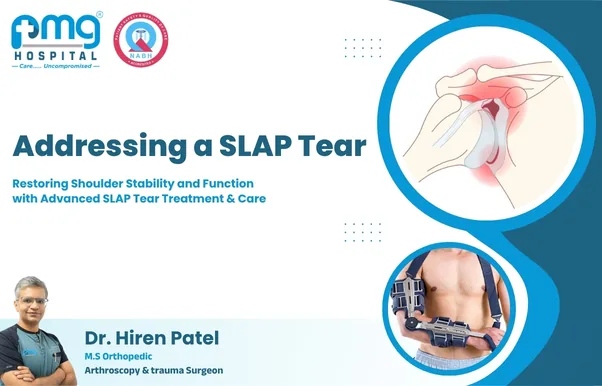
- For deep shoulder pain and lost throwing power
- MRI-arthrogram used to confirm the tear
- Arthroscopic labral repair in younger throwers
- Biceps tenodesis where repair is likely to fail
What is a SLAP tear?
SLAP stands for Superior Labrum Anterior to Posterior - a tear of the labrum at the very top of the socket, running from front to back, right where the long head of the biceps tendon attaches. Because the biceps anchor is part of the injury, a SLAP tear is really a problem of both the labrum and the biceps together, which is what makes it behave differently from other labral tears and shapes how it is treated.
Causes and symptoms
SLAP tears happen in two broad ways: a sudden injury, such as a fall onto an outstretched hand or a jerk on the arm, or the repetitive overhead loading of throwing and bowling that wears the anchor over time. Older labrums also fray as a degenerative change. The symptoms are often vague, which is why these tears are frequently missed:
- A deep ache inside the shoulder, hard to point to
- Pain and clicking or catching with overhead movements
- Loss of power or velocity in throwers and bowlers
- A sense that the shoulder is not working as it should, more than sharp pain
How a SLAP tear is diagnosed
A SLAP tear is difficult to see on a plain MRI, so an MRI arthrogram - where dye is injected into the joint first - is usually needed to show the tear clearly, alongside specific clinical tests. Even then, the final confirmation is often made arthroscopically at the time of surgery, because the appearance of the top labrum varies with age and a normal variant can mimic a tear. This is exactly why experience matters: over-treating a normal-looking labrum is as much a mistake as missing a real tear.
Repair or tenodesis?
The treatment has changed as understanding has improved. In a younger patient, particularly an overhead athlete, the torn labrum is repaired arthroscopically with anchors, restoring the biceps anchor to the top of the socket. In patients over about forty, however, repairing the SLAP lesion often gives stiff, disappointing results - so instead the biceps tendon is released and re-fixed lower down (a biceps tenodesis), which reliably removes the pain without the stiffness. Choosing correctly between these is the central decision, and it turns mainly on age and the demands placed on the shoulder.
Recovery after SLAP tear surgery
After a labral repair, a sling is worn for about four weeks and overhead movement is limited early to protect the anchor, with active movement over the following weeks and strengthening from around six weeks. A structured throwing programme is introduced later, and return to overhead sport is generally around six months.
After a biceps tenodesis, recovery is a little quicker, with lifting and resisted elbow bending avoided for about six weeks. Everyday activities are comfortable within a couple of months in both cases; the throwing shoulder simply takes longer, because it is the last, most demanding function to return.
- Experience
- 14+ years
- Surgeries
- 14,000+
SLAP tear specialist in Ahmedabad
SLAP tears reward accurate diagnosis and, above all, the right choice between repairing the labrum and moving the biceps - a decision that has caught out many shoulders that were repaired when they should have had a tenodesis. Dr. Hiren Patel completed a dedicated international fellowship in Sports Medicine & Shoulder Surgery at St. Mary's Catholic Hospital, Seoul, South Korea, alongside 14+ years of orthopaedic practice and 14,000+ surgeries at PMG Hospital, Gota. Learn more about Dr. Hiren Patel, or see related biceps tenodesis and shoulder dislocation.
Frequently asked questions
Does a SLAP tear always need surgery?
No. Many SLAP tears, especially degenerative ones in patients who are not overhead athletes, settle with physiotherapy that strengthens the shoulder and corrects technique, along with activity modification and sometimes an injection. Surgery is considered when pain and loss of power persist despite a proper course of non-surgical treatment, or in a young athlete whose sport depends on the shoulder.
Why would the biceps tendon be moved instead of the labrum repaired?
Because in patients over about forty, repairing the SLAP lesion often leaves the shoulder stiff and painful, whereas releasing the biceps and re-fixing it lower down (a tenodesis) reliably removes the pain without that stiffness. In younger throwers the labrum is usually repaired instead, to preserve the biceps anchor. The choice turns mainly on age and the demands on the shoulder.
How is a SLAP tear different from a Bankart tear?
Both are labral tears, but in different places and with different consequences. A SLAP tear is at the top of the socket where the biceps anchors, and causes pain and lost power; a Bankart tear is at the front and lower rim and causes the shoulder to dislocate. A SLAP tear is treated for pain, a Bankart tear for instability.