
Biceps Tenodesis surgeon in Ahmedabad, Gujarat
Relocating the Biceps Tendon
Pain at the front of the shoulder that travels down the upper arm often comes from the long head of the biceps tendon where it passes through the joint. Biceps tenodesis moves that tendon out of the joint and fixes it to the arm bone, removing the source of pain while keeping the muscle working. Dr. Hiren Patel performs biceps tenodesis surgery in Ahmedabad at PMG Hospital.
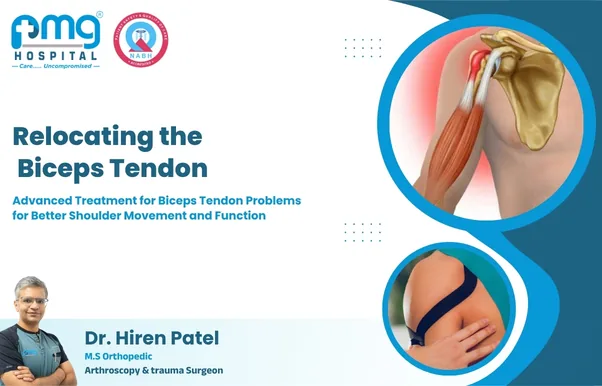
- For front-of-shoulder pain and biceps tendinitis
- Tendon released and refixed to the arm bone
- Often combined with rotator cuff repair
- Preserves biceps strength and contour
What is biceps tenodesis?
The biceps muscle has two tendons at its upper end. The long head runs up into the shoulder joint and over the top of the ball, through a narrow groove in the arm bone - an awkward course that makes it a common source of pain. When that tendon becomes inflamed, frayed or unstable in its groove, it hurts at the front of the shoulder and often refers to pain down the arm.
Biceps tenodesis divides the tendon where it enters the joint and reattaches it lower down, to the arm bone outside the joint. The painful portion inside the joint is taken out of the equation while the muscle keeps its attachment, so elbow bending and forearm rotation stay strong.
Who needs biceps tenodesis
It is considered when front-of-shoulder pain is clearly coming from the biceps tendon and has not settled with physiotherapy, activity modification and sometimes an injection. The common situations are:
- Long head of biceps tendinitis that persists despite non-surgical treatment
- A partially torn or frayed biceps tendon
- An unstable tendon that slips out of its groove
- A SLAP tear where the tendon anchor has pulled off the socket rim
- As part of a rotator cuff repair, where the biceps is a further source of pain
Tenodesis or tenotomy?
There are two ways to take a painful biceps tendon out of the joint. A tenotomy simply releases it and lets it retract - quicker, and reliably effective at relieving pain - but it can leave a visible bulge in the upper arm (the so-called "Popeye" sign) and occasionally some cramping or loss of forearm-rotation strength. A tenodesis re-anchors the tendon and avoids both, at the cost of a slightly longer operation and a period of protected recovery.
Tenodesis is generally preferred for younger, active or slimmer patients, where appearance and strength matter more, while a tenotomy remains a reasonable choice for older or lower-demand patients. The decision is made with you before surgery.
How biceps tenodesis is performed
Under general anaesthesia with a nerve block, the shoulder is inspected arthroscopically and the biceps tendon assessed along its course. The tendon is released at its origin on the socket rim, then fixed to the upper arm bone either arthroscopically or through a small incision at the front of the arm using a screw or an anchor, at a point that sits below the painful groove.
Because the biceps is so often one problem among several, the same anaesthetic usually addresses whatever else is found: a bursa cleared, a bone spur trimmed, or a labral or rotator cuff tear repaired. Most patients go home the same day.
Recovery after biceps tenodesis
A sling is worn for about two to four weeks to protect the fixation while it takes hold. Gentle shoulder and elbow movement starts early, but active bending of the elbow against resistance and lifting are avoided for around six weeks, since those load the repair directly. Strengthening follows from about six to eight weeks.
Front-of-shoulder pain usually settles within the first weeks. Most patients return to daily activities by two to three months, with full strength for lifting and sport at around four to six months. Where the tenodesis was done alongside a rotator cuff repair, the cuff rehabilitation sets the pace and recovery is longer.

- Experience
- 14+ years
- Surgeries
- 14,000+
biceps tenodesis specialist in Ahmedabad
Biceps pain is easily attributed to the rotator cuff or the joint itself, so the value lies in identifying it correctly and then choosing between release and re-fixation for that particular patient. Dr. Hiren Patel completed a dedicated international fellowship in Sports Medicine & Shoulder Surgery at St. Mary's Catholic Hospital, Seoul, South Korea, alongside 14+ years of orthopaedic practice and 14,000+ surgeries at PMG Hospital, Gota. Learn more about Dr. Hiren Patel, or see related rotator cuff repair.
Frequently asked questions
Will my arm be weaker after biceps tenodesis?
No. The tendon is reattached to the arm bone rather than removed, so the muscle keeps a working attachment and elbow bending and forearm rotation stay strong. That is the main reason tenodesis is preferred over a simple release in younger and more active patients.
What is the Popeye sign?
The "Popeye" sign is a visible bulge in the upper arm that can appear when the biceps tendon is released and allowed to retract (a tenotomy) rather than re-anchored. It is usually cosmetic and painless, but avoiding it - along with keeping full strength - is exactly why a tenodesis is chosen for slimmer, younger or more active patients.
Is biceps tenodesis done on its own?
Sometimes, but often not. The biceps is frequently one of several sources of shoulder pain, so a tenodesis is commonly done in the same sitting as a rotator cuff repair, a labral repair, or the trimming of a bone spur or inflamed bursa. When it is the only problem, it can be done on its own as a short procedure.
How soon can I lift after the surgery?
Active lifting and bending the elbow against resistance are avoided for about six weeks to protect the fixation, with strengthening added from around six to eight weeks. Full strength for heavier lifting and sport usually returns at four to six months - longer if a rotator cuff repair was done at the same time.