
Revision Knee Replacement in Surgeon Ahmedabad, Gujarat
Restoring a Failed Knee Implant
Revision knee replacement is a corrective procedure that replaces a failed, loose, worn or infected knee implant with a new one, restoring stability, movement and pain-free function. It is considerably more demanding than a first-time replacement; it calls for careful planning, specialised implants and advanced surgical technique. Dr. Hiren Patel is a revision knee replacement surgeon in Ahmedabad with 14+ years of experience and 14,000+ surgeries, managing complex and infected revision cases at PMG Hospital.
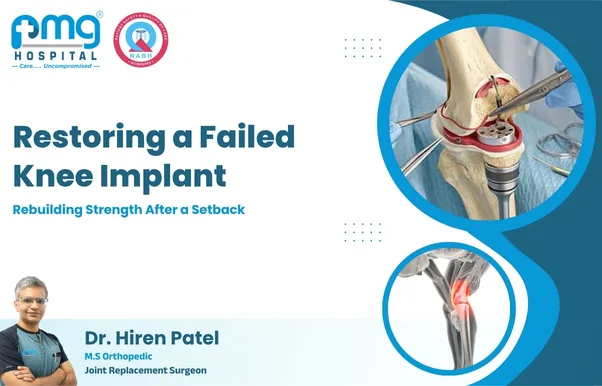
- For failed, loose, infected or worn implants
- Two-stage revision for infected implants
- Bone grafts and augmented implants where bone is lost
- Revision implants often last around 10–15 years
What is revision knee replacement?
Revision knee replacement, sometimes called a redo or second knee replacement, is surgery to remove a previously implanted knee prosthesis and replace it with a new one. It is not simply a repeat of the first operation. Because bone and soft tissue have already been altered, and part of the bone stock may have been lost, the surgeon often rebuilds the joint using stems, metal augments or bone grafts to give the new implant a stable foundation. The goal is to correct whatever caused the first implant to fail and return the knee to reliable, pain-free movement.
Signs you may need revision surgery
Persistent pain, swelling, or a feeling that the knee is giving way long after a previous replacement are the most common warnings that an implant is failing and should be assessed. These symptoms can appear gradually over years or come on more quickly if infection is involved.
- Pain that returns or never fully settled after a previous replacement
- Swelling, warmth or fluid that keeps coming back
- The knee feeling loose, unstable or "giving way"
- New stiffness or a reduced range of movement
- A grinding sensation, or the leg drifting out of alignment
Why knee implants fail
A knee implant can fail for several reasons, and identifying the exact cause is what decides the revision plan. The main causes are:
- Loosening — the implant gradually loses its grip on the bone, the commonest long-term cause
- Wear and osteolysis — the plastic spacer wears, and debris triggers bone loss around the implant
- Infection — bacteria form a protective biofilm on the implant that antibiotics alone cannot clear
- Instability — the soft-tissue balance is lost and the knee feels unreliable
- Stiffness — dense scar tissue restricts bending and straightening
- Periprosthetic fracture — a break in the bone around the implant, often after a fall
Diagnosis before revision surgery
A revision is never planned on symptoms alone. The assessment combines a clinical examination with standing X-rays that show implant position, loosening and bone loss, and blood tests - including ESR and CRP - that screen for hidden infection. Where infection is suspected, fluid is drawn from the joint (aspiration) and cultured, because whether infection is present completely changes the operation that follows. A CT scan is sometimes added to map bone defects before surgery. Ruling infection in or out is the single most important step, since an infected implant and a loose-but-clean implant are treated in entirely different ways.
How revision knee replacement surgery is performed
The old implant is carefully removed while preserving as much healthy bone as possible. The bone surfaces are then prepared, any defects are filled with bone grafts or metal augments, and stems are used to anchor the new components deeper into the bone. Where the ligaments can no longer provide stability, a more constrained or hinged implant is chosen to do that work instead. Every revision is planned individually around the reason for failure and the amount of bone remaining.
Treating an infected implant: two-stage revision
An infected implant is usually treated in two stages. In the first operation the implant is removed, the joint is thoroughly cleaned, and a temporary antibiotic-loaded cement spacer is placed, followed by several weeks of antibiotics. Once tests confirm the infection has cleared, a second operation removes the spacer and fits the final new implant. This staged approach exists because bacteria form a biofilm on the old implant that cannot be reliably cleared while any of the original hardware remains. In selected cases a single-stage revision may be considered, but two-stage remains the more dependable route for established infection.
The TRINOVA Approach in Revision Knee Replacement
Revision surgery is technically more demanding than a first replacement, since the old implant, scarred tissue and any bone loss must all be managed carefully. Dr. Hiren Patel applies three additional elements - TRINOVA - to improve precision and reduce trauma even in these complex cases.
Robotic assistance (ROSA)
ROSA measures the knee live during surgery, so implant size, position and limb alignment follow the surgical plan rather than the feel of the moment. In revision cases, where normal bony landmarks may be distorted by bone loss or a previous implant, this real-time measurement helps re-establish accurate alignment that can be difficult to judge by eye alone.
Subvastus approach
Where scarring from the earlier surgery allows, the knee is opened underneath the vastus medialis instead of cutting through the quadriceps tendon, so the muscle that straightens your leg is preserved. Protecting this muscle matters even more in revision surgery, since the leg has already been through one operation and a second cut through the tendon would add further trauma.
Tourniquet-less surgery
The operation is done without a thigh tourniquet, so blood supply to the leg muscles is never cut off during surgery. In revision cases, where soft tissue is already compromised by scarring or prior infection, maintaining continuous blood flow supports better tissue healing and helps limit post-operative swelling.
Recovery after revision knee replacement
Recovery is slower and more gradual than after a primary knee replacement, because more work has been done to the bone and soft tissues. Most patients regain significant mobility within three to six months, though full recovery can take up to a year depending on the complexity of the revision and whether infection was involved. Weight-bearing may be restricted in the early weeks where grafts or augments have been used, and a structured, patient physiotherapy programme is central to a good result.

- Experience
- 14+ years
- Surgeries
- 14,000+
Why revision surgery needs an experienced specialist
Revision knee replacement is complex work: the implant must be removed without sacrificing bone, defects must be rebuilt, soft tissues must be re-balanced, and infection must be recognised and managed correctly. This depends on specialised implants and instruments, longer operating times and refined technique - which is why patients look specifically for an experienced revision knee replacement surgeon, doctor or hospital in Ahmedabad rather than for primary-replacement volume alone.
Dr. Hiren Patel brings 14+ years of practice and 14,000+ surgeries, with international fellowship training in joint replacement, to failed, loosened and infected knee implants. Because revision uses specialised implants and takes longer than a first replacement, its cost is usually higher and is quoted individually after assessment. Learn more about Dr. Hiren Patel, or read the wider knee replacement overview.
Frequently asked questions
Why is revision knee surgery more complex than the first replacement?
Because the old implant must be removed without damaging bone, lost bone often has to be rebuilt with grafts, augments or stems, scarred soft tissues must be re-balanced, and any infection has to be cleared first. It needs specialised implants, longer operating time and advanced technique, so outcomes depend heavily on the surgeon's revision experience.
How long do revision knee implants last?
A revision implant often lasts around 10–15 years, though this varies with the reason for the original failure, the amount of bone remaining and whether infection was involved. Weight control, sensible activity and avoiding infection all help it last longer.
What causes a knee implant to fail?
The main causes are loosening, plastic wear with bone loss (osteolysis), infection, instability, stiffness, and fractures around the implant. Failure can appear years after an otherwise successful replacement, which is why lasting pain or swelling should always be assessed.
How long is recovery after revision knee replacement?
Recovery is slower than after a first replacement. Most patients regain significant mobility within three to six months, with full recovery taking up to a year depending on the complexity of the revision and whether infection was treated.
Is Dr. Hiren Patel experienced in revision knee surgery?
Yes. Dr. Hiren Patel has 14+ years of practice and 14,000+ surgeries, with international fellowship training in joint replacement, and manages complex revision cases including loosened and infected implants at PMG Hospital, Ahmedabad.