
ACL Tear & Reconstruction surgeon in Ahmedabad, Gujarat
Rebuilding a Torn ACL Ligament
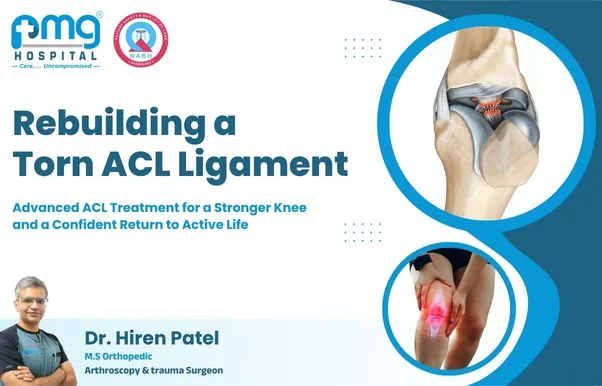
The anterior cruciate ligament (ACL) stops your knee from shifting forward and twisting out of control. Once torn it does not heal on its own and every episode of the knee giving way damages the meniscus and cartilage a little more. Dr. Hiren Patel performs arthroscopic ACL reconstruction surgery in Ahmedabad through keyhole incisions, with a sport-specific rehabilitation plan, at PMG Hospital.
- Keyhole surgery through two small incisions
- Hamstring or quadriceps graft options
- Day-care or single-night admission
- Return to sport in 6-9 months with rehab
Signs you may have torn your ACL
Most ACL tears in Ahmedabad happen during cricket, football, kabaddi or badminton, or in a two-wheeler accident - typically a twist on a planted foot, often with an audible pop. The common signs are:
- A pop at the moment of injury followed by rapid swelling
- The knee giving way when turning, pivoting or stepping off a kerb
- Being unable to trust the leg on stairs or uneven ground
- Recurrent swelling after activity
If the knee keeps giving way, it is worth getting assessed early, because each episode of instability can tear the meniscus and wear the cartilage.
The reconstruction procedure
A torn ACL cannot simply be stitched back together. It is replaced with a graft taken from your own hamstring or quadriceps tendon, passed through precisely drilled tunnels in the thigh bone (femur) and shin bone (tibia) and secured with modern suspensory or interference fixation devices. The whole procedure is done arthroscopically through two keyhole incisions, so the muscles are not cut, and any associated meniscus tear is repaired in the same sitting. The operation usually takes about one to two hours, and most patients go home the same day or after a single night.
Rehabilitation timeline
Walking with support starts on day one. Full knee bend is usually achieved by around week four, light jogging by month three to four, and pivoting sport at six to nine months - but only once strength testing confirms the knee is ready. Rushing back to sport is the single biggest cause of re-tear, so the programme is milestone-based, not calendar-based: you progress when your knee meets each target, not simply when time has passed. Getting the knee fully straight early and rebuilding quadriceps strength are the priorities in the first weeks.

- Experience
- 14+ years
- Surgeries
- 14,000+
ACL reconstruction surgeon in Ahmedabad
A good ACL result depends on accurate graft placement and a disciplined, milestone-based rehabilitation plan - the reconstruction and the rehab matter equally. Dr. Hiren Patel is an orthopaedic surgeon in Ahmedabad with 14+ years of practice and 14,000+ surgeries at PMG Hospital, Gota, and an international fellowship in Sports Medicine & Shoulder Surgery, reconstructing the ACL arthroscopically and repairing any associated meniscus tear in the same sitting. Sportspersons from clubs and academies across Ahmedabad, Gandhinagar, Vadodara, Surat and Rajkot are managed on the same evidence-based protocol. Learn more about Dr. Hiren Patel or see related knee trauma surgery.
Frequently asked questions
Can an ACL tear heal without surgery?
A torn ACL does not heal back together on its own. Someone with a partial tear or low physical demands can sometimes manage well with a structured physiotherapy programme that strengthens the muscles around the knee. But for anyone active, playing pivoting sports, or whose knee keeps giving way, reconstruction is recommended - because each episode of instability damages the meniscus and cartilage further.
Is ACL reconstruction a major operation, and is it painful?
It is keyhole (minimally invasive) surgery, usually done as a day-care procedure, but because it rebuilds a major ligament using a graft and tunnels drilled in the bone, it is still a significant operation. Most of the pain and swelling settle within the first couple of weeks with regular painkillers, ice and elevation, and the keyhole approach makes recovery far more comfortable than open surgery.
Which graft is better - hamstring or quadriceps?
There is no single "best" graft; the right choice depends on you. A hamstring graft is the most common, with a smaller incision and less kneecap pain. A quadriceps graft is thick and strong and is often preferred in larger patients or for revision surgery. Dr. Hiren Patel selects the graft based on your build, your sport and the state of the knee.
How soon after injury should ACL surgery be done?
Usually not immediately. Surgery is typically done once the initial swelling has settled and the knee has regained its full range of movement, often two to six weeks after injury, because operating on a stiff, swollen knee raises the risk of stiffness afterwards. The exception is a knee locked by an associated meniscus tear, which may need earlier attention.
How long before I can walk normally after ACL surgery?
You will walk with support from day one. Most people are walking without crutches within two to four weeks and with a normal gait by around six to eight weeks. If a meniscus repair was done at the same time, weight-bearing is protected for longer to let the meniscus heal, so the timeline is a little slower.
When can I return to sport after ACL reconstruction?
Pivoting and contact sport is usually resumed at six to nine months, and only after strength and functional testing confirm the knee is ready - not simply because a certain time has passed. Returning too early is the single biggest cause of re-tearing the graft.
Can a reconstructed ACL tear again?
Yes, a reconstructed ACL can re-tear, most often when sport is resumed too early or the rehabilitation is left incomplete. Completing the full milestone-based programme and passing strength testing before returning to pivoting sport is the best way to protect the new ligament.
What is the cost of ACL surgery in Ahmedabad?
The cost depends on the graft chosen, the fixation implants, whether a meniscus repair is needed at the same time, and whether admission is day-care or overnight. A written, itemised estimate is provided before surgery, and many insurance policies cover ACL reconstruction when it follows an injury.