
Knee Dislocation Treatment & surgeon in Ahmedabad, Gujarat
Correcting a Dislocated Knee
A dislocated knee is one of the most serious injuries in orthopaedics: the joint comes completely apart, tearing several of the ligaments that hold it together and putting the artery behind the knee at risk. Dr. Hiren Patel treats knee dislocation in Ahmedabad with urgent reduction and careful vascular assessment first, followed by planned ligament reconstruction, at PMG Hospital.
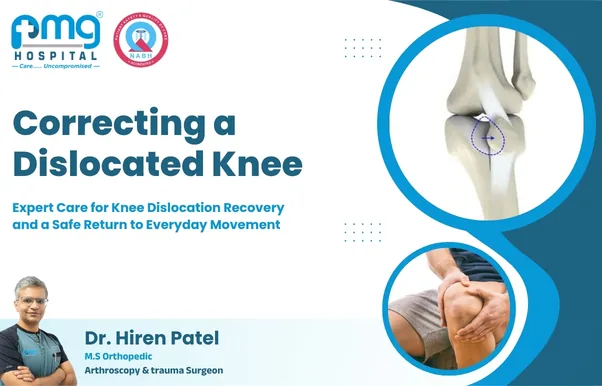
- Urgent reduction and circulation check
- Multi-ligament injury assessed on MRI
- Arthroscopic ACL and PCL reconstruction
- Staged surgery where the knee is unstable
What is a knee dislocation?
A knee dislocation happens when the thigh bone and shin bone are forced completely out of alignment with each other, rather than simply spraining a ligament. Because the knee is held together almost entirely by its ligaments, the joint cannot come apart without tearing at least two of them and usually three or four. It is different from a kneecap (patellar) dislocation, which is far more common and much less serious. Most true knee dislocations follow a road accident, a fall from height or a heavy sporting collision, though they can also occur after a relatively low-energy fall in patients carrying significant extra weight.
Why a knee dislocation is an emergency
The popliteal artery, which carries the blood supply to the whole lower leg, runs directly behind the knee and is tethered there. When the joint dislocates, that artery can be stretched, torn or blocked, and the leg itself is then at risk. The nerves behind the knee can be injured in the same way, causing weakness or numbness in the foot.
For that reason a dislocated knee is reduced - put back into position - as an emergency, and the circulation is checked immediately and again over the following hours, because an arterial injury does not always declare itself straight away. Where there is any doubt, a CT angiogram or vascular opinion is obtained before anything else is planned. Some knees reduce themselves before the patient reaches hospital, which can hide how severe the injury was, so a knee that is grossly unstable after a high-energy accident is treated as a dislocation until proven otherwise.
Which ligaments are injured
An MRI, once the knee is reduced and stable, maps exactly which structures have torn - and that map decides the reconstruction plan.
- Anterior cruciate ligament (ACL) - torn in the large majority of knee dislocations
- Posterior cruciate ligament (PCL) - the ligament most characteristically involved
- Medial collateral ligament (MCL) and the inner corner of the knee
- Lateral collateral ligament (LCL) and the posterolateral corner
- The meniscus and joint cartilage, often damaged alongside the ligaments
How a dislocated knee is treated
Once the joint is reduced, the circulation confirmed and the swelling settled, the knee is held in a brace or - where it will not stay reduced - by a temporary external fixator. Reconstruction is then planned rather than rushed, because operating into a swollen, stiff knee gives a worse result than waiting a short period for the soft tissues to recover.
The cruciate ligaments are reconstructed arthroscopically using grafts, in the same way as an isolated ACL reconstruction or PCL reconstruction, while the collateral ligaments and corners are repaired or reconstructed through small open incisions. Depending on how many structures are involved, this may be done in one longer operation or staged across two, and any meniscal or cartilage damage is addressed at the same time.
Recovery after knee dislocation surgery
Recovery is longer than after a single ligament injury, because several structures are healing at once and the knee has to be protected against both instability and stiffness at the same time. A brace controls movement in the early weeks, weight-bearing is introduced gradually, and physiotherapy is started early to prevent the joint scarring down. Most patients regain functional daily movement over six to nine months, with sport or heavy work considered at around a year, and some residual stiffness or laxity is common after such a severe injury.

- Experience
- 14+ years
- Surgeries
- 14,000+
Knee dislocation specialist in Ahmedabad
A dislocated knee needs the right decisions in the first hours - reduction, a careful check of the circulation, and imaging before any reconstruction is planned - and then the experience to rebuild several ligaments in the correct order. Dr. Hiren Patel is an orthopaedic surgeon in Ahmedabad with 14+ years of practice and 14,000+ surgeries at PMG Hospital, Gota, with international fellowship training in Sports Medicine & Shoulder Surgery and arthroscopy. Learn more about Dr. Hiren Patel or see related knee trauma surgery.
Frequently asked questions
Is a dislocated knee the same as a dislocated kneecap?
No, and the difference matters. A kneecap (patellar) dislocation is common, usually settles with a brace and physiotherapy, and is not limb-threatening. A true knee dislocation means the joint itself has come apart, tearing several ligaments, and it carries a real risk of injury to the artery behind the knee.
Why does the circulation need checking repeatedly?
Because an injury to the popliteal artery behind the knee does not always show itself immediately. The artery can be bruised, or its inner lining torn, during the dislocation, and the blood flow can fail hours later even if the foot looked fine at first. Repeated checks - and a CT angiogram or vascular opinion where there is any doubt - are there to catch that in time to save the leg.
Does every knee dislocation need surgery?
Almost always, because a true knee dislocation tears several ligaments and the knee cannot be stable without them being repaired or reconstructed. The urgent steps are reduction and protecting the circulation; the ligament surgery itself is then planned once the knee has settled. Only rarely, in a frail patient or where surgery is unsafe, is a braced, non-surgical route chosen, accepting some lasting instability.
How long is recovery after a knee dislocation?
Longer than after a single ligament tear. Most patients regain functional daily movement over six to nine months, with a return to sport or heavy work considered at around a year. Some stiffness or residual laxity is common, and consistent physiotherapy is the biggest factor in the final result.