
Shoulder Dislocation Surgeon in Ahmedabad, Gujarat
Stabilizing a Dislocating Shoulder
The shoulder is the most frequently dislocated joint in the body, because the shallow socket that gives it such a wide range of movement also makes it easy to displace. Dr. Hiren Patel treats shoulder dislocation in Ahmedabad - from prompt reduction of a first-time dislocation to arthroscopic stabilisation for a shoulder that keeps coming out - at PMG Hospital.
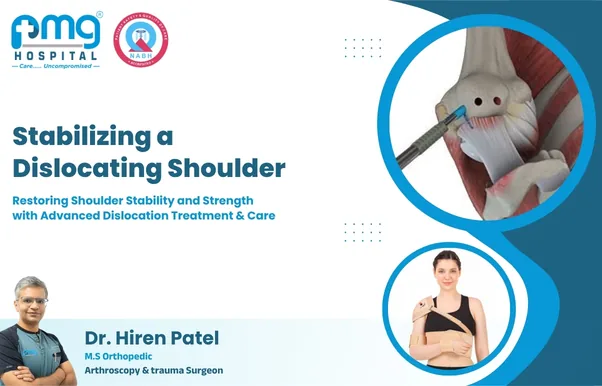
- Prompt reduction and nerve assessment
- Arthroscopic Bankart repair for recurrent instability
- Latarjet where the socket bone is worn
- Rehabilitation aimed at preventing recurrence
What happens in a shoulder dislocation?
In the large majority of cases the ball is forced forwards out of the socket, usually when the arm is pulled backwards and outwards - a fall onto an outstretched hand, a tackle, or a heavy overhead movement. As it comes out, it commonly tears the labrum, the rim of cartilage that deepens the socket, away from the front of the bone. That injury is called a Bankart lesion, and it is the reason a dislocated shoulder so often dislocates again: the socket has effectively been made shallower still.
The ball can also dent itself against the rim of the socket on the way out, and in more forceful injuries a piece of the socket bone breaks away. How much bone has been lost is one of the main things that decides which operation is appropriate later.
Treating a first-time dislocation
A dislocated shoulder is reduced as soon as possible, under sedation, and the nerves and circulation in the arm are checked before and afterwards - the axillary nerve running around the top of the arm bone is the one most often affected, so any numbness over the outer shoulder is noted. X-rays confirm the ball is back in place and look for a fracture.
A sling is then worn for comfort for a short period, followed by physiotherapy to rebuild the muscles that stabilise the shoulder. Most first-time dislocations in older patients are treated this way. In younger, active patients an MRI is often arranged, because the risk of dislocating again is high and early stabilisation may be the better course.
Recurrent shoulder instability
The younger you are at your first dislocation, the more likely the shoulder is to keep dislocating. The risk is highest in teenagers and those in their twenties, and in contact-sport athletes. Each further dislocation tends to damage a little more labrum and a little more bone, which makes the shoulder progressively easier to displace and harder to repair well.
Some patients never fully dislocate but describe the shoulder slipping, catching or feeling as though it is about to come out when they reach behind them. That sensation of apprehension is instability too, and it is assessed in the same way with an MRI, and often a CT scan where bone loss is suspected.
Stabilisation surgery
Where the labrum has torn but the socket bone is largely intact, an arthroscopic Bankart repair is the usual operation. Through keyhole incisions the torn labrum is freed, the socket rim prepared, and anchors placed in the bone are used to reattach the labrum and re-tension the ligaments, restoring the depth and the front wall of the socket.
Where a significant amount of socket bone has been lost - typically after several dislocations - a soft-tissue repair alone is likely to fail, and a bone-block procedure such as a Latarjet is used instead. This transfers a small piece of bone with its attached tendon to the front of the socket, both deepening it and adding a sling effect that holds the ball in place. Which operation suits your shoulder is decided on imaging, your age and the demands you place on the arm.
Recovery after shoulder stabilisation
A sling is worn for about four weeks, with gentle movement guided by a physiotherapist from early on and outward rotation limited at first to protect the repair. Active movement is regained over the following weeks, and strengthening starts at around six to eight weeks.
Everyday activities are comfortable by about three months. Return to contact sport is generally not permitted before six months - and sometimes later - because the repair needs to be fully mature before it is tested. Completing the rehabilitation programme is what protects against dislocating again.

- Experience
- 14+ years
- Surgeries
- 14,000+
Shoulder Dislocation specialist in Ahmedabad
The decision that matters in an unstable shoulder is whether a keyhole repair will hold, or whether enough bone has been lost that it needs a bone-block procedure - getting that wrong is the commonest reason stabilisation fails. Dr. Hiren Patel completed a dedicated international fellowship in Sports Medicine & Shoulder Surgery at St. Mary's Catholic Hospital, Seoul, South Korea, alongside 14+ years of orthopaedic practice and 14,000+ surgeries at PMG Hospital, Gota. Learn more about Dr. Hiren Patel, or see related SLAP tear and rotator cuff repair.
Frequently asked questions
Will my shoulder dislocate again?
It depends most on your age at the first dislocation. In teenagers and young adults, and particularly in contact-sport athletes, the risk of recurrence is high; in older patients it is much lower. A structured physiotherapy programme reduces the risk, and stabilisation surgery is considered when the shoulder keeps coming out despite it.
Do I need surgery after my first dislocation?
Not always. Many first-time dislocations, especially in older patients, are treated with reduction, a short period in a sling, and physiotherapy. In younger, active patients - where the risk of it happening again is high - an MRI is often arranged and early stabilisation may be advised, because each further dislocation damages more labrum and bone.
What is the difference between a Bankart repair and a Latarjet?
A Bankart repair is a keyhole operation that reattaches the torn labrum and re-tensions the ligaments, and is used when the socket bone is largely intact. A Latarjet is a bone-block procedure that transfers a piece of bone with its tendon to the front of the socket, used when significant socket bone has been lost and a soft-tissue repair alone would likely fail. Imaging decides which one your shoulder needs.