
Total Knee Replacement in Surgeon Ahmedabad, Gujarat
Resurfacing All Three Knee Compartments
Total knee replacement surgery in Ahmedabad replaces a severely damaged knee joint with an artificial implant to relieve pain and restore movement. Dr. Hiren Patel is a total knee replacement surgeon in Ahmedabad with 14+ years of experience and 14,000+ surgeries, performing total knee replacement at PMG Hospital, using both conventional and ROSA robotic-assisted technique for accurate alignment.
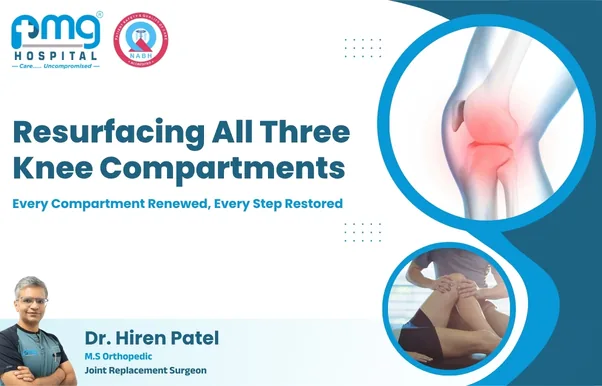
- All three knee compartments resurfaced
- Conventional and ROSA robotic-assisted alignment
- Implants typically last 15–20 years or more
- Standing and walking within 24 hours
What is total knee replacement?
Total knee replacement (total knee arthroplasty) resurfaces all three compartments of a knee worn out by arthritis. The damaged cartilage and a few millimetres of bone are removed from the end of the thigh bone and the top of the shin bone, and smooth metal components with a plastic spacer between them are fitted to recreate a pain-free, moving joint. Your own ligaments and muscles continue to support the knee, so the procedure is more accurately a resurfacing than a full removal of the joint.
It is the right choice when arthritis affects the whole knee rather than a single compartment. Where only the inner side is worn, a smaller partial (unicondylar) replacement may be enough - which is confirmed on standing X-rays before surgery.
Who needs total knee replacement?
Total knee replacement is recommended once severe pain or stiffness limits daily activities and swelling no longer responds to rest or medication. It is considered only after physiotherapy, injections and medicines have stopped giving lasting relief, and every case is examined thoroughly before surgery is advised.
- Severe osteoarthritis affecting all three knee compartments
- Pain that disturbs sleep or limits walking distance
- Deformity such as bowing or knock-knee
- A failed previous knee surgery or a loosened implant
- Rheumatoid or post-traumatic arthritis of the whole joint
How total knee replacement surgery is performed
Under spinal or general anaesthesia, an incision is made at the front of the knee. The damaged cartilage and bone are removed, and the femur and tibia are shaped to receive the implant. The metal components are fixed in place with antibiotic-loaded bone cement and a plastic spacer is set between them, restoring a smooth, stable, well-aligned joint. With ROSA robotic assistance, the planned angles are displayed in real time so alignment is confirmed before the components are fixed. The incision is closed, and physiotherapy begins the same day. A single knee usually takes 45–90 minutes.
Total vs partial knee replacement
Total knee replacement resurfaces the whole joint and suits widespread arthritis or deformity, while a partial replacement treats only one worn compartment through a smaller incision with a faster recovery.
| Total knee replacement | Partial knee replacement | |
|---|---|---|
| Best for | Two or three compartments damaged, deformity | Isolated inner-compartment wear, intact ligaments |
| Incision & recovery | Standard incision, everyday activity 6–8 weeks | Smaller incision, faster early recovery |
| Hospital stay | 2–3 days | 1–2 days |
The right option is decided on your standing X-rays and examination, not on preference alone.
The TRINOVA Approach to Total Knee Replacement
Dr. Hiren Patel's total knee replacement follows a three-part approach - TRINOVA - designed around accuracy, muscle preservation and blood-flow safety, rather than surgeon feel alone.
Robotic assistance (ROSA)
ROSA measures the knee live during surgery, so implant size, position and limb alignment follow the surgical plan rather than the feel of the moment. This real-time measurement reduces guesswork and supports a more consistently balanced knee.
Subvastus approach
The knee is opened underneath the vastus medialis instead of cutting through the quadriceps tendon, so the muscle that straightens your leg is left intact. Preserving this muscle can mean less early pain and a quicker return of normal walking and stair-climbing.
Tourniquet-less surgery
The operation is done without a thigh tourniquet, so blood supply to the leg muscles is never cut off during surgery. This reduces post-operative swelling and muscle stiffness, helping the leg feel less "dead" in the first few days after surgery.
Together, these three elements aim for a knee replacement that is planned with robotic precision, performed with less muscle trauma, and recovered from with better early leg function.
Recovery after total knee replacement
Most patients stand and take a few assisted steps the same evening or the next morning, with gentle stair-climbing within a few days. Discharge is usually on day two or three with minimal support. Comfortable everyday activity typically returns by 6–8 weeks, and full strength and recovery over 3–6 months. A structured physiotherapy programme - daily bending and straightening exercises - is what turns a painless joint into a strong, functional knee, so it matters as much as the surgery itself.
Total knee replacement cost in Ahmedabad
Total knee replacement in Ahmedabad typically costs between Rs 1.5 lakh and Rs 4 lakh per knee, depending on implant type, whether ROSA robotic assistance is used, and hospital room category. A written, itemised estimate is provided after consultation, and most insurance policies cover the procedure once the joint-replacement waiting period is complete, with cashless pre-authorisation coordinated where applicable. Figures are indicative and confirmed in writing after your consultation.

- Experience
- 14+ years
- Surgeries
- 14,000+
Total knee replacement Specialist in Ahmedabad
Dr. Hiren Patel is a total knee replacement surgeon in Ahmedabad with 14+ years of practice and 14,000+ surgeries at PMG Hospital. His training includes international fellowships in joint replacement across France, Switzerland, Italy and South Korea, and he offers both conventional and ROSA robotic-assisted total knee replacement. Learn more about Dr. Hiren Patel or read the wider knee replacement overview. Second opinions on X-rays, and on a knee replacement already advised elsewhere, are welcome.
When choosing a total knee replacement doctor or hospital in Ahmedabad, it helps to look at surgical volume and sub-specialisation in joint replacement, access to robotic or computer-navigated alignment, a transparent written estimate, and a clear follow-up pathway.
Frequently asked questions
How long does a total knee implant last?
A modern total knee implant typically lasts 15–20 years or more. Joint registries report that roughly 90–95% are still working at fifteen years and more than 80% at twenty to twenty-five years. Longevity depends on body weight, alignment at surgery, activity level and avoiding infection.
Can both knees be replaced in one surgery?
Yes. Bilateral total knee replacement in a single sitting is offered to medically fit patients with cardiac clearance, giving one anaesthetic and one recovery period. The early weeks are more demanding because there is no unoperated leg to lean on, so for older or less fit patients the two knees are usually staged.
What does total knee replacement cost in Ahmedabad?
Total knee replacement in Ahmedabad typically costs between Rs 1.5 lakh and Rs 4 lakh per knee. The main variables are implant type and material, whether ROSA robotic assistance is used, and hospital room category. You receive a written estimate after consultation, and most policies cover the procedure once the waiting period is complete.
Is robotic (ROSA) total knee replacement available?
Yes. Both conventional and ROSA robotic-assisted total knee replacement are offered. Robotic assistance improves the accuracy of alignment by displaying the planned angles in real time before the implant is fixed, which can support a smoother early recovery.
How long is recovery after total knee replacement?
You stand and take a few steps the same day and usually go home in two to three days. Comfortable everyday activity returns by six to eight weeks, and full strength and recovery over three to six months, with physiotherapy driving the result.