
Knee Replacement Surgeon in Ahmedabad, Gujarat
Resurfacing a Worn Knee Joint
When knee arthritis makes stairs, walking or getting up from a chair painful, knee replacement can restore years of easy movement. Dr. Hiren Patel is a knee replacement surgeon in Ahmedabad with 14+ years of experience and 14,000+ surgeries, offering total, partial, revision and robotic-assisted knee replacement with TriNova (ROSA) planning for accurate alignment - for patients across Ahmedabad and Gujarat looking for an experienced knee replacement specialist.
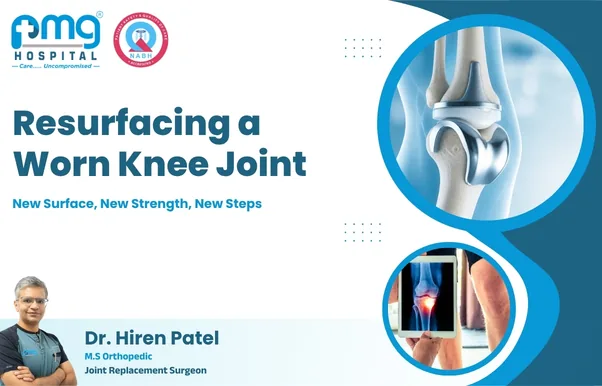
- Total, partial and revision knee replacement
- TriNova robotic and computer-navigated alignment
- High-flexion implants for the Indian floor-sitting lifestyle
- Walk the same day, discharge in 2–3 days
What is knee replacement?
Knee replacement (knee arthroplasty) resurfaces a joint worn down by arthritis or injury. Damaged cartilage and bone are removed and replaced with smooth metal and medical-grade plastic components that recreate a pain-free, moving joint.
The whole knee is not taken out; only about eight to ten millimetres of the worn surface is trimmed from the thigh and shin bone, and thin metal caps are fitted over what remains. Your own ligaments and muscles hold the knee together afterwards, which is why the operation is better described as resurfacing than replacement.
Who needs knee replacement?
Knee replacement is recommended when the cartilage is worn down and non-surgical treatments no longer control pain. Typical signs include:
- Severe osteoarthritis or rheumatoid arthritis
- Knee pain despite medicines, injections and physiotherapy
- Difficulty climbing stairs, squatting or sitting cross-legged
- Deformity such as bowing or knock-knee
- A failed previous knee surgery or a loosened implant
- Post-traumatic arthritis after an old fracture or ligament injury
Age alone neither qualifies nor disqualifies you; what matters is the gap between the life you want and the life the knee currently allows.
Types of knee replacement offered
Not every arthritic knee needs a total replacement. Total, partial and revision knee replacement in Ahmedabad are all offered here, alongside robotic-assisted knee replacement that combines ROSA planning with a muscle-sparing Subvastus approach.
| Type | Best suited for | Hospital stay | Return to routine |
|---|---|---|---|
| Total knee replacement | Two or three compartments damaged, deformity, inflammatory arthritis | 2–3 days | 6–12 weeks |
| Partial (unicondylar) | Isolated inner-compartment wear with intact ligaments | 1–2 days | 4–8 weeks |
| TriNova robotic knee replacement | Patients wanting maximum alignment accuracy | 2–3 days | 6–10 weeks |
| Revision knee replacement | Loosening, instability or infection in a previous implant | 4–7 days | 3–6 months |
| Bilateral (both knees together) | Both knees severely arthritic, patient medically fit | 3–5 days | 8–14 weeks |
Timelines are typical ranges and are individualised after your assessment.
Diagnosis before knee replacement
A confident diagnosis rests on three things: how the knee limits daily life, what the examination finds, and what the imaging shows.
What X-rays are needed?
Standing X-rays are essential - a knee filmed lying down can look almost normal in a joint that collapses under body weight. A full-length hip-to-ankle scanogram measures the true limb axis and is required for robotic and computer-navigated planning.
Is an MRI required?
For most patients with advanced arthritis an MRI adds cost, not information, since a standing X-ray already shows bone-on-bone wear. It is reserved for a near-normal X-ray with severe pain, suspected avascular necrosis, or planning a partial replacement.
What tests are done before surgery?
Routine blood tests, sugar/HbA1c control, an ECG, a dental check and screening for any skin or urinary infection are completed first, because an implant must go in with no hidden source of infection.
Non-surgical treatment options
Most people with knee arthritis do not need surgery this year. Adequate-dose paracetamol and short courses of anti-inflammatories manage pain, a structured physiotherapy programme reduces it without medicine, and weight control is the single most powerful step - every kilogram lost removes three to four kilograms of force from the knee with each step. Corticosteroid or hyaluronic-acid injections can break a flare but disappoint in a bone-on-bone knee. These measures have run their course when pain wakes you at night, walking shrinks to a few minutes, painkillers are needed most days, or the knee locks or gives way - the point at which knee replacement becomes the reasonable next step.
Knee replacement surgery: step by step
Anaesthesia and the surgical approach
Most knee replacements are done under spinal anaesthesia with an ultrasound-guided nerve block, so the leg is numb while you stay awake and can walk the same evening. Through a muscle-sparing Subvastus approach, a few precise millimetres are trimmed from the femur and tibia at angles calculated from your scanogram. With ROSA robotic assistance, the screen shows the actual angles in real time, so any deviation is corrected before a single cut is made. The components are then fixed with antibiotic-loaded bone cement, and a tourniquet-less technique lowers thigh pain and swelling in the first week.
How long does knee replacement surgery take?
A single knee takes 45–90 minutes, with about two hours of total theatre time; both knees in one sitting take 2–2.5 hours. The surgeon speaks to the family immediately afterwards.
Knee replacement implants
A knee implant caps the worn surfaces - a metal shell on the thigh bone, a metal tray on the shin bone, a cross-linked polyethylene insert acting as new cartilage, and sometimes a button behind the kneecap. Your own ligaments provide stability.
| Implant design | Typically chosen for |
|---|---|
| Cruciate retaining (CR) | Good bone stock, mild deformity, intact PCL |
| Posterior stabilised (PS) | Larger deformity, inflammatory arthritis |
| High-flexion | Patients needing deeper safe bending |
| Unicondylar (partial) | Isolated medial wear, intact ACL, no deformity |
| Constrained / hinged | Revision, severe deformity, ligament deficiency |
A costlier implant is not automatically better; what predicts a good result is accurate alignment, balanced ligaments and an infection-free procedure.
How long do knee implants last?
With modern cross-linked polyethylene, joint registries report roughly 90–95% of total knee replacements still working at fifteen years and more than 80% at twenty to twenty-five years. Weight control, strong quadriceps and prompt treatment of any infection protect that lifespan.
Recovery after knee replacement
Most patients stand and take a few steps the same evening, and a structured physiotherapy programme is essential for the best result.
Recovery timeline
- First 24 hours — sensation returns in four to six hours; you stand and walk a few steps.
- Days 2–7 — walking distance grows, stair practice begins, discharge on day two or three; bending 70–90°.
- Weeks 2–4 — walker exchanged for a stick; bending 100–110°, sutures gone by day 12–14.
- 6 weeks — a 20–30 minute outdoor walk, comfortable stairs with a railing, bending 110–120°.
- 3 months — walking feels normal, strength 70–80% restored.
- 6–12 months — quadriceps strength keeps improving; residual numbness and clicking fade.
When can you walk, drive and return to work?
You walk the same day with a walker, and comfortable unassisted stair-climbing returns at four to six weeks. Driving resumes at four to six weeks for a right knee (three to four for a left knee in an automatic), once you are off strong painkillers. Desk work is usually possible in three to four weeks, standing jobs in eight to twelve weeks, and heavy manual work in three to four months.
Activities to avoid
Avoid running, jumping and high-impact sport, deep squatting and kneeling on hard floors, Indian-style toilets permanently, and lifting heavy loads while turning. Treat any dental, urinary or skin infection promptly and mention your implant.
Physiotherapy after knee replacement
Surgery gives you a painless joint; physiotherapy turns it into a working knee. In the first six weeks, two things are fought: scar tissue and quadriceps inhibition - both of which respond well to daily work and poorly to catching up later. Early exercises are short and frequent: ankle pumps, static quadriceps, straight-leg raises, and knee extension over a rolled towel for full straightening.
Knee bending targets after surgery
| Stage | Bending target |
|---|---|
| Day 3–7 | 70°–90° |
| Week 2–3 | 100°–110° |
| Week 4–6 | 110°–120° |
| Month 3 | 120°–130° |
Supervised sessions run four to six weeks; a home programme continues three to six months.
Pain after knee replacement
The surgery itself is painless. The first two to three days afterwards are uncomfortable rather than severe and are controlled with multimodal pain relief - a nerve block, local infiltration, scheduled paracetamol and anti-inflammatories, tranexamic acid, ice and early walking. By about six weeks, most patients report that daily pain is already less than the arthritis pain they had before.
When to contact the clinic urgently
Contact the clinic the same day if pain increases after day five, you develop fever or chills, the wound discharges or spreads redness, you get calf pain or swelling with breathlessness, or you suddenly cannot bear weight - these can signal infection or a clot. Call +91 96627 70141.
Knee replacement cost in Ahmedabad, Gujarat
Knee replacement in Ahmedabad typically costs between Rs 1.5 lakh and Rs 4 lakh per knee, depending on implant type, whether TriNova robotic assistance is used, and hospital room category. The clinic provides a written, itemised estimate before you decide, and cashless pre-authorisation is coordinated with major insurers and TPAs. Patients travel to this Ahmedabad centre from across Gujarat - Gandhinagar, Nadiad, Mehsana, Anand, Surat, Vadodara and Rajkot.
What determines knee replacement surgery cost?
The biggest variables are the implant type and material, conventional vs robotic-assisted technique, room category, and whether one or both knees are done in a sitting. The written estimate covers the implant, surgeon and anaesthesia fees, the 2–3 day hospital stay, pre-operative tests and medicines, in-hospital physiotherapy, and follow-up at six weeks, three months and one year. Figures are indicative and confirmed in writing after your consultation.

- Experience
- 14+ years
- Surgeries
- 14,000+
Knee Replacement Surgery Specialist in Ahmedabad, Gujarat
Dr. Hiren Patel is a knee replacement surgeon in Ahmedabad with 14+ years of practice and 14,000+ surgeries at PMG Hospital, Gota. His training includes international fellowships in joint replacement across France, Switzerland, Italy and South Korea - the background behind the CROWN partial-replacement technique and the TriNova robotic-assisted knee replacement offered here. Learn more about Dr. Hiren Patel.
How to choose a knee replacement Doctor
When comparing a knee replacement doctor or surgeon in Ahmedabad, look for surgical volume and sub-specialisation in joint replacement rather than general orthopaedics; access to robotic or computer-navigated alignment where appropriate; a transparent, written estimate; the ability to handle complex and revision cases; and a clear follow-up pathway.
Frequently asked questions
How much does knee replacement cost in Ahmedabad?
Knee replacement in Ahmedabad typically costs between Rs 1.5 lakh and Rs 4 lakh per knee. The main variables are implant type and material, whether robotic assistance is used, room category, and single versus both knees. You receive a written, itemised estimate before deciding, and cashless insurance/TPA pre-authorisation is coordinated where applicable.
How long does a knee replacement last?
Modern implants last well beyond fifteen years in most patients, and joint registries report that roughly eight to nine out of ten knees are still working at twenty years. Longevity depends on body weight, alignment at surgery, bone quality and avoiding infection.
Is knee replacement surgery painful?
The operation itself is painless because the leg is numb from spinal anaesthesia and a nerve block. The first two to three days afterwards are uncomfortable rather than severe and are well controlled with modern pain relief. By about six weeks, most patients report that daily pain is less than the arthritis pain they had before.
What is the difference between total and partial knee replacement?
Total knee replacement resurfaces all three compartments and suits knees with widespread damage or deformity. Partial (unicondylar) replacement resurfaces only one worn compartment through a smaller incision with a faster recovery, and suits isolated medial wear with intact ligaments.
Is robotic knee replacement better than conventional surgery?
Robotic assistance improves the accuracy of alignment by showing real-time angles before any cut is made, which can mean a gentler first fortnight. It supports the surgeon's judgement rather than replacing it, and a well-aligned conventional knee can perform just as well. Whether it benefits you depends on your anatomy.
What warning signs after knee replacement need immediate attention?
Contact the clinic the same day for pain that increases after day five, fever or chills, wound discharge or spreading redness, calf pain or swelling with breathlessness, or a sudden inability to bear weight. These can signal infection or a clot, both best treated early.