
Cartilage Damage & Restoration surgeon in Ahmedabad, Gujarat
Repairing Damaged Knee Cartilage
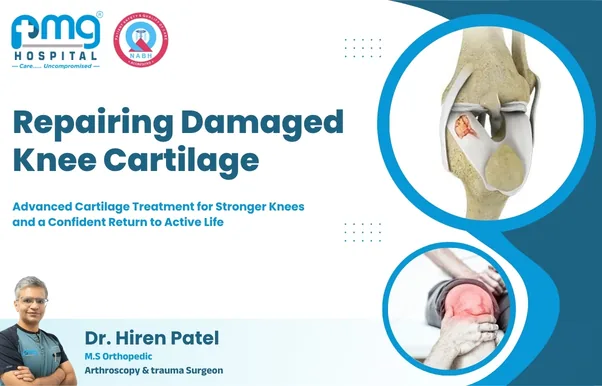
Articular cartilage is the glassy white surface that lets your knee glide without friction. It has no blood supply, so once it is chipped or worn it does not repair itself - and treating a defect early can delay or even avoid joint replacement altogether. Dr. Hiren Patel treats knee cartilage in Ahmedabad with defect-specific restoration techniques, at PMG Hospital.
- MRI-based mapping of the defect
- Microfracture and marrow stimulation
- Osteochondral transfer for contained defects
- Realignment osteotomy to offload the damaged side
Why cartilage damage causes pain
A cartilage defect exposes the bone underneath, which is richly supplied with nerves. The typical complaint is a deep, aching pain after standing or walking, sometimes with swelling and a grinding sensation. The problem is not only the pain now: untreated defects enlarge, and the surrounding cartilage begins to break down - the pathway to osteoarthritis. Treating a defect while it is still small and contained is what protects the rest of the joint.
Treatment options
The right technique depends on the size, depth and site of the defect, mapped first on an MRI. The main options are:
- Microfracture - tiny perforations in the bone stimulate marrow cells to fill a small defect with repair tissue
- Osteochondral autograft (OATS) - healthy cartilage-and-bone plugs are transferred from a non-weight-bearing area to a contained defect
- Cell-based and scaffold techniques - used for larger lesions, growing or supporting new cartilage tissue
- High tibial osteotomy - realigns the leg to shift load away from the damaged compartment, protecting the repair
- Injection therapy and weight management - supporting measures that ease symptoms and reduce load on the joint
Realistic expectations
Cartilage procedures need patience. Protected weight-bearing for about six weeks and continuous passive motion are essential, with meaningful improvement over six to twelve months as the repair tissue matures. The results are best when the damage is a single, contained defect rather than widespread arthritis. Cartilage preservation is discussed with patients from across Gujarat - including Surat, Vadodara and Rajkot - before joint replacement is even considered, because a well-treated defect can delay replacement by years.

- Experience
- 14+ years
- Surgeries
- 14,000+
Cartilage restoration specialist in Ahmedabad
Matching the right technique to the defect and knowing when a defect is restorable versus when the joint has moved on to arthritis is what makes the difference in cartilage surgery. Dr. Hiren Patel is an orthopaedic surgeon in Ahmedabad with 14+ years of practice and 14,000+ surgeries at PMG Hospital, Gota, and an international fellowship in Sports Medicine & Shoulder Surgery, offering microfracture, osteochondral transfer, cell-based techniques and offloading osteotomy. Because he also performs joint replacement, the advice on whether to preserve or replace is balanced. Learn more about Dr. Hiren Patel, or see related meniscus repair and the knee replacement overview.
Frequently asked questions
Can damaged knee cartilage grow back?
Cartilage does not grow back on its own, because it has no blood supply. Surgery can encourage a repair - techniques like microfracture prompt the body to fill a small defect - but the new tissue is usually a tougher, less perfect "fibrocartilage" rather than the original glassy surface. There is no injection or tablet available today that reliably regrows true cartilage, so claims otherwise should be treated with caution.
Can cartilage restoration help me avoid a knee replacement?
That is exactly its aim. Treating a focal cartilage defect early - before the surrounding cartilage breaks down into widespread arthritis - can relieve pain and delay or avoid a replacement, sometimes by years. It works best when the damage is a contained defect rather than generalised arthritis, which is why early assessment matters.
Am I too old for cartilage repair?
Age matters, but it is not an absolute barrier. Cartilage restoration works best in younger, active knees with a single, contained defect and otherwise healthy cartilage. In older patients with early focal damage it can still help, but once the joint has widespread arthritis a partial or total knee replacement usually gives a more reliable result. The decision is made on the state of the joint, not age alone.
Do injections help cartilage damage?
Injections such as hyaluronic acid or PRP, together with weight management, can ease symptoms and support the joint, but they do not rebuild lost cartilage. They are useful as supporting treatment or to buy time, not as a substitute for repairing a significant defect, and claims that injections "regrow cartilage" are not supported by current evidence.
How long is recovery after cartilage surgery?
Cartilage procedures need patience. Weight-bearing is protected for about six weeks and continuous passive motion is used to nourish the repair, with meaningful improvement over six to twelve months as the repair tissue matures. Returning to load too early can damage the immature surface, so the programme is followed carefully.