
Total Shoulder Replacement Surgeon in Ahmedabad, Gujarat
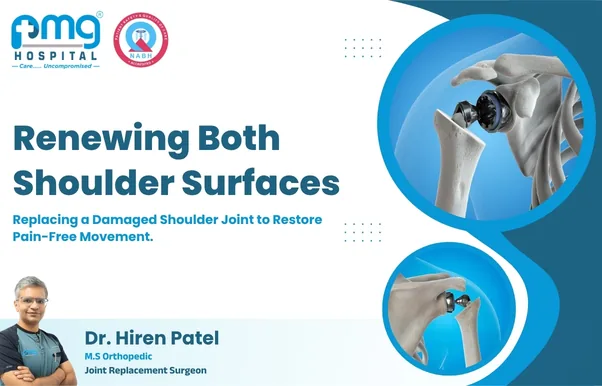
Renewing Both Shoulder Surfaces
Total shoulder replacement surgery restores the function and stability of a painful, damaged shoulder by removing the worn joint surfaces and replacing them with artificial implants. Dr. Hiren Patel is a total shoulder replacement surgeon in Ahmedabad with 14+ years of experience and 14,000+ surgeries, offering anatomic, reverse and stemless shoulder replacement at PMG Hospital, Gota with the implant matched to your rotator cuff status and the underlying condition.
- Anatomic, reverse and stemless implant options
- For arthritis, cuff tear arthropathy and fracture
- Implants typically last 15–20 years or more
- Structured rehabilitation from day one
What is total shoulder replacement?
Total shoulder replacement (shoulder arthroplasty) replaces both worn surfaces of the shoulder joint, the ball at the top of the arm bone and the shallow socket on the shoulder blade with artificial components, relieving pain and restoring the movement needed for dressing, reaching and sleeping comfortably. Because the shoulder relies on the surrounding rotator cuff for stability, the condition of those muscles decides which implant configuration is used, so a total shoulder replacement is planned around your anatomy rather than being a single fixed operation.
Who needs total shoulder replacement?
Total shoulder replacement is considered for severe shoulder pain that has not responded to conservative treatment such as medicines, physiotherapy and injections. The common causes are:
- Osteoarthritis of the shoulder
- Rheumatoid or post-traumatic arthritis
- Rotator cuff tear arthropathy
- Avascular necrosis of the humeral head
- A severe shoulder fracture that cannot be reliably reconstructed
Anatomic, reverse and stemless implant options
The right implant is chosen from your rotator cuff status — confirmed on an MRI — not from preference.
Anatomic total shoulder replacement places the ball on the arm side and the socket on the shoulder side, recreating natural anatomy. It suits arthritis with an intact, repairable rotator cuff.
Reverse shoulder replacement swaps the ball and socket positions so the powerful deltoid muscle lifts the arm in place of a torn, irreparable cuff — used for rotator cuff tear arthropathy and some complex fractures.
Stemless implants use a shorter humeral component that preserves more bone, an option for patients with good bone quality and an intact cuff, and one that can make any future revision easier.
How total shoulder replacement surgery is performed
Under general anaesthesia combined with an interscalene nerve block, and with you positioned semi-seated, the shoulder is reached through the interval at the front of the joint without cutting the deltoid. The damaged head of the arm bone is removed and the socket prepared, and the planned components are fitted with a ball and stem on the humerus with a resurfaced socket in an anatomic replacement, or the ball and socket positions swapped in a reverse replacement. Trial components confirm stability and tension before the final implants are placed, and the arm is supported in a sling before you leave the theatre. Hospital stay is usually one to two days.
Recovery after total shoulder replacement
The arm is supported in a sling for two to four weeks, and physiotherapy begins early — gentle pendulum and passive movements first, protecting the healing repair, before active movement and then strengthening. Most patients notice a clear reduction in pain within the first few weeks. Because the legs are unaffected, walking continues from day one. Functional recovery for daily tasks takes about three months, with full strength and confident overhead use over six to twelve months; reverse replacements often reach comfortable daily function a little sooner, since the deltoid takes over the lifting role early. Pushing active movement too soon can tear a healing repair, so the phased programme is followed on your surgeon's advice.
Total shoulder replacement cost in Ahmedabad
Total shoulder replacement cost depends on the implant configuration — anatomic, reverse or stemless — the surgical complexity and the length of hospital stay. A written, itemised estimate covering the implant, surgeon and anaesthesia fees, the one-to-two-day stay, pre-operative workup including MRI, physiotherapy and follow-up is provided before admission, and most insurance policies cover the procedure once the waiting period is complete. Figures are confirmed in writing after your consultation.

- Experience
- 14+ years
- Surgeries
- 14,000+
Total shoulder replacement specialist in Ahmedabad
Shoulder replacement is technically distinct from knee or hip surgery, so specific shoulder training matters. Dr. Hiren Patel completed a dedicated international fellowship in Sports Medicine & Shoulder Surgery at St. Mary's Catholic Hospital, Seoul, South Korea, alongside 14+ years of orthopaedic practice and 14,000+ surgeries at PMG Hospital, Gota. When choosing a total shoulder replacement doctor or hospital in Ahmedabad, look for this kind of sub-specialised shoulder training and clear MRI-based planning of the implant. Learn more about Dr. Hiren Patel, or read the wider shoulder replacement overview.
Frequently asked questions
What is the difference between anatomic and reverse shoulder replacement?
An anatomic replacement keeps the natural arrangement — ball on the arm, socket on the shoulder blade — and suits arthritis with an intact rotator cuff. A reverse replacement swaps those positions so the deltoid muscle powers the arm, and is used when the rotator cuff is torn and irreparable. The MRI findings on your cuff decide which one fits.
What is a stemless shoulder replacement?
A stemless implant uses a shorter humeral component that sits in the top of the arm bone without a long stem, preserving more of your own bone. It is an option for patients with good bone quality and an intact rotator cuff, and it can make any future revision surgery more straightforward.
How long does a shoulder replacement last?
A shoulder replacement typically lasts 15 to 20 years or more, depending on the implant type, your activity level and whether the rotator cuff remains functional. Reverse implants have a strong track record in older, lower-demand patients.
Can both shoulders be replaced?
Yes, both shoulders can be replaced, but they are almost always done as separate, staged operations rather than together, because you need at least one working arm to manage daily tasks and rehabilitation while the other heals. The timing between them is planned around your recovery.
What does total shoulder replacement cost in Ahmedabad?
The cost depends on the implant configuration (anatomic, reverse or stemless), the surgical complexity and the length of hospital stay. A written, itemised estimate is provided before admission, and most insurance policies cover the procedure once the waiting period is complete.