
Orthopedic Trauma & Fracture Care in Ahmedabad, Gujarat
Care for Fractures, Dislocations, and Injuries
Orthopaedic trauma covers broken bones, dislocations, and injuries to the ligaments, meniscus and tendons, most often after a road accident, a fall or a sporting collision. Prompt assessment, treatment matched to each injury and a planned rehabilitation programme help restore function.
At PMG Hospital, Gota, Ahmedabad, emergency and trauma care is available 24×7, and injuries ranging from a single closed fracture to multiple serious injuries are treated.
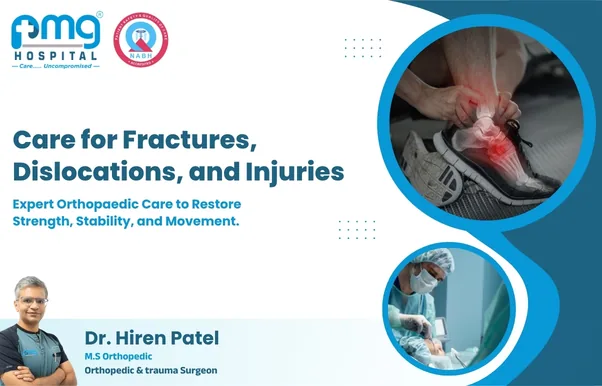
- Emergency fracture fixation
- Hip and knee trauma, including the choice between fixing and replacing a broken hip
- Joint dislocations and fracture-dislocations
- Open (compound) fractures and care for multiple injuries
What Counts as Orthopedic Trauma?
Orthopaedic trauma is any sudden injury to the bones, joints or soft tissues of the limbs, ranging from a simple closed fracture to a limb-threatening open fracture, a dislocation, or several serious injuries at once. It differs from wear-and-tear conditions such as arthritis because it happens suddenly and often needs time-sensitive treatment. The priority is to restore the alignment of the bone and the stability of the joint, so that the limb heals in the right position and moves well afterwards. Some injuries can wait for a planned operation; others must be treated urgently.
Trauma Surgery Specialities
Each type of injury is described on its own page:
- Knee Trauma Surgery: knee fractures and dislocations, ligament (ACL and PCL), meniscus, tendon and cartilage injuries
- Bone Fracture Surgery: plates, screws, nailing and external fixation, including open (compound) fractures
- Shoulder and Elbow Trauma Surgery: collarbone, upper arm (proximal humerus) and elbow fractures and fracture-dislocations
- Polytrauma Surgery: staged, damage-control care for multiple serious injuries
- Hip Trauma Surgery: fractures of the top of the thigh bone, including the femoral neck, and hip dislocations, treated by fixation or replacement
Conditions Treated
The injuries treated include:
- Closed fractures of the arm and leg
- Fractures involving a joint surface
- Open (compound) fractures
- Hip fractures needing fixation or replacement
- Joint dislocations and fracture-dislocations
- Knee ligament, meniscus and tendon injuries
- Fractures that have not healed (non-union) or have healed in a poor position (malunion)
- Multiple fractures in a severely injured patient
How an Injury Is Assessed
A trauma and fracture doctor in Ahmedabad — an orthopaedic surgeon who treats injuries of the bones and joints — first checks the circulation, the nerves and the skin over the injury, because a cold or numb limb, or a wound over a fracture, changes how urgently treatment is needed. X-rays are taken in at least two directions, usually including the joints above and below the injury. A CT scan is often used for fractures that involve a joint surface, and an MRI scan for ligament, meniscus or tendon injuries, or when a fracture is suspected but does not show on X-rays.
Trauma and Fracture Treatment in Ahmedabad: With or Without Surgery
Trauma and fracture treatment in Ahmedabad does not always mean surgery. Undisplaced and stable fractures that stay in a good position often heal well in a cast, brace or sling, with regular X-rays to check that the position holds.
Surgery is usually advised when a fracture is displaced, unstable, open or involves a joint surface, or when it fails to heal. The broken bone is held with plates, screws, wires or a rod inside the bone (a nail), or with an external frame; for some hip fractures, the ball of the hip is replaced instead.
Emergency and After-Hours Care
Some injuries are time-critical, such as an open fracture, a joint dislocation (especially of the hip or knee, or one cutting off the circulation), a broken hip, or a major accident with several injuries. These need emergency care without delay rather than a scheduled appointment: call 108 or go to the nearest emergency facility. Emergency and trauma care is available 24×7 at PMG Hospital.
Many closed fractures, by contrast, are treated on a planned list within a few days, once swelling settles and the patient is prepared for surgery, so a prompt OPD visit is usually appropriate for a stable injury.
Recovery and Rehabilitation
Each injury is followed by a recovery plan matched to it: protected movement early to prevent stiffness, physiotherapy to rebuild strength and range of movement, and follow-up X-rays to confirm healing before more load is allowed. Many fractures unite in about six to twelve weeks, while fractures of large bones such as the thigh bone and shin bone, joint-surface injuries, open fractures, hip fractures and ligament reconstructions follow their own timelines and are sometimes treated in stages. The aim is to return the limb to useful, everyday function.
Risks and Possible Complications
Fracture treatment, with or without surgery, can have complications. The possible complications of fracture surgery include:
- Infection of the wound or around the implant, which may need further surgery
- Delayed healing or non-union (the bone not joining), or healing in a poor position (malunion), which may need further surgery
- Stiffness of the nearby joints
- Blood clots in the leg veins (deep vein thrombosis) or lungs (pulmonary embolism), especially after leg and pelvic injuries
- Injury to nerves or blood vessels, which is uncommon
- Compartment syndrome, a dangerous build-up of pressure in the muscles after some fractures, which needs urgent surgery
- Implant problems, such as irritation, loosening or breakage, sometimes needing removal or further surgery
- Wound problems, such as delayed healing
- Anaesthesia-related and general medical risks
- Arthritis later in life after a fracture that involves a joint surface
The surgeon explains the risks that apply to you before you decide on treatment.
Trauma and Fracture Treatment Cost in Ahmedabad
The cost depends on:
- The type of injury and whether surgery is needed
- The implants used (plates, screws, nails or an external frame) or a joint replacement
- Whether one operation or several staged operations are needed
- Length of hospital stay and room category
- Tests such as X-rays, CT or MRI scans, and medicines
- Physiotherapy and follow-up visits
A written, itemised estimate can be requested from the hospital after assessment.
Insurance
- Medically necessary fracture treatment is generally covered under health insurance policies, subject to policy terms, waiting periods and insurer approval
- Some policies have limits on room rent or implant costs; check these with your insurer before surgery
- Ask the hospital whether cashless treatment is available with your insurer, and which documents are needed
How to Choose a Trauma and Fracture Surgeon in Ahmedabad
When choosing a trauma and fracture surgeon in Ahmedabad, check that the surgeon is a qualified orthopaedic surgeon with valid medical council registration, that the procedure is performed regularly, how infection is prevented, whether emergency care is available at all hours, which implants are used, what physiotherapy and follow-up are provided, and what the written estimate includes.
Look beyond general phrases such as "trauma & fracture surgeon with modern facilities" and ask which facilities are actually available at the hospital where the treatment will be done.
Trauma and Fracture Doctor in Ahmedabad
Broken bones, dislocations and other limb injuries are treated by an orthopaedic surgeon, often after first care from an emergency doctor. Depending on how serious the injury is, a trauma and fracture doctor in Ahmedabad may work alongside several others:
| Doctor or therapist | Role |
|---|---|
| Emergency doctor | Checks breathing, circulation and bleeding first, controls pain, splints the limb and calls the orthopaedic team |
| Orthopaedic surgeon | Examines the limb, reads the X-rays and scans, decides between a cast and surgery, and fixes the fracture or replaces the joint |
| Radiologist | Reports the X-rays, and the CT or MRI scans used for joint-surface, ligament or hidden fractures |
| Anaesthetist | Gives anaesthesia or a nerve block for surgery or for setting a fracture |
| General surgeon or neurosurgeon | Treats chest, abdominal or head injuries in a patient with multiple injuries |
| Plastic surgeon | Helps cover the bone with skin or muscle after some open fractures |
| Physiotherapist | Restores movement, strength and walking as the bone heals |
Trauma and Fracture Surgery Doctor in Ahmedabad
After an injury, a few clear answers make the treatment plan easier to follow at home. Questions you may wish to put to the trauma and fracture surgery doctor in Ahmedabad include:
- Is the fracture displaced, and does it involve the surface of a joint?
- If a cast or brace is used, how often will X-rays be repeated to check the position?
- If surgery is advised, will plates, screws, a nail or an external frame be used, and why?
- Is the operation needed now, or after the swelling has settled?
- Will the implant stay in permanently, or might it be removed later?
- How much load can the limb take now, and when will that be increased?
- Which signs, such as a cast that feels too tight or numb fingers or toes, should make me contact the hospital at once?
- When can I return to work, driving or sport, and what follow-up visits are planned?
About the Treating Surgeon
At PMG Hospital, Gota, Ahmedabad, trauma and fracture care is provided by:
| Detail | Information |
|---|---|
| Name | Dr. Hiren Patel |
| Qualification | MBBS, MS (Ortho), International Fellowship in Joint Replacement |
| Education | MBBS and MS (Ortho), B.J. Medical College, Ahmedabad |
| Specialty | Orthopaedics |
| Designation | Director & Head Joint Replacement Surgeon, PMG Hospital |
| Registration status | Registered Medical Practitioner |
| Registration number | Gujarat Medical Council Reg. No. G-20583 |
| OPD availability | Monday to Saturday, 10:00 AM – 8:00 PM; Sunday by appointment |
Facilities at PMG Hospital
- Orthopaedic OPD, Monday to Saturday; Sunday by appointment
- Emergency and trauma care, 24×7
- Orthopaedic physiotherapy
Frequently asked questions
Is a fracture always a medical emergency?
Not always. Open fractures, joint dislocations (especially of the hip or knee, or any that affect the circulation), broken hips and major multi-injury accidents are emergencies that need immediate care. Many closed fractures are stable enough to be treated on a planned list within a few days, once swelling settles, but any fracture with severe deformity, a wound over the bone, numbness or a cold, pale limb should be treated as urgent. For a severe injury, call 108 or go to the nearest emergency facility.
Do all fractures need surgery?
No. Undisplaced and stable fractures that stay in a good position often heal well in a cast, brace or sling. Surgery is usually advised when a fracture is displaced, involves a joint surface, is unstable, is open, or fails to heal. Fixation with plates, screws, wires or a nail, or for some hip fractures a replacement, restores alignment and allows earlier movement.
Which trauma injuries are treated at PMG Hospital?
Adult limb injuries are treated, including knee trauma, hip trauma, shoulder and elbow trauma, closed and open fractures of the arm and leg, and multiple injuries (polytrauma). Each has its own page. Dislocations, and knee ligament and meniscus injuries, are covered on these pages.
Should I go to the emergency department or visit the OPD?
For a severe injury, such as an obvious deformity, a wound over the bone, loss of circulation, a suspected broken hip or a high-energy accident, call 108 or go to the nearest emergency facility straight away. For a stable, less severe injury, or for follow-up of an injury already treated, an OPD visit is usually appropriate.
Contact and Location
PMG Hospital
3rd Floor, Athena Avenue, B/H Jaguar Showroom, Nr. Eulogia Inn Hotel, Gota, Ahmedabad, Gujarat
Phone / WhatsApp: +91 96627 70141
Email: pmghospital.ahm@gmail.com
OPD: Monday to Saturday, 10:00 AM – 8:00 PM; Sunday by appointment
Emergency and trauma care: 24×7
Medically reviewed by Dr. Hiren Patel, MS (Ortho.), Joint Replacement Surgeon, PMG Hospital, Ahmedabad.